What Is the Fundamental Purpose of an O-Ring?
The fundamental purpose of an O-ring is to create a tight, leak-proof barrier between two or more mating components.
How Does an O-Ring Create a Seal?
An O-ring is seated in a groove (or gland) and is slightly compressed during assembly. This initial compression provides the sealing force at low or no system pressure.
How Does Pressure Activate an O-Ring Seal?
When system pressure (from a fluid or gas) is applied, the essentially incompressible elastomer material acts like a highly viscous fluid. The pressure transfers through the O-ring's cross-section, further deforming it and increasing the contact stress on the sealing surfaces. This phenomenon allows O-rings to seal effectively, often up to 5,000 psi (34 MPa), as long as the material does not fail mechanically (like extruding into a gap).
Where Are O-Rings Used?
O-rings are used in both static (no relative movement between the sealed parts, e.g., pipes, flanges, valves) and dynamic (relative movement between parts, e.g., rotating pump shafts, hydraulic cylinder pistons) applications across virtually all industries, including aerospace, automotive, medical, and plumbing.
What Materials Are O-Rings Made From?
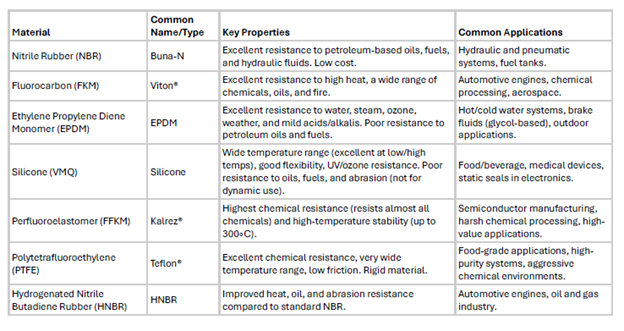
O-rings are made from a wide variety of materials, primarily elastomers (synthetic rubbers), but also from plastics and metals, to suit specific environmental demands like temperature, chemical compatibility, and pressure. Selecting the correct material is critical for seal longevity and performance (see chart below).
What Are the Alternatives to O-Rings?
While O-rings are often the best choice, several alternative sealing components exist, particularly for specialized dynamic applications or for use under extremely high pressure or low-friction requirements.
What Are X-Rings (or Quad-Rings®)?
Description: Have an 'X' or four-lobed cross-section, providing four contact points instead of two.
Advantage: Less friction and twisting/spiraling in dynamic (reciprocating) applications compared to standard O-rings.
Substitution: They are often interchangeable with standard O-ring groove sizes.
What Are U-Cup Seals (Lip Seals)?
Description: Have a 'U' shaped cross-section and are a type of lip seal. They can be "loaded" with an internal O-ring or spring for low-pressure sealing force.
Advantage: Longer sealing life and lower friction in dynamic rod and piston applications.
Application: Commonly used in hydraulic and pneumatic cylinders.
What Are Encapsulated O-Rings (FEP/PFA)?
Description: An elastomer core (like Silicone or Viton) covered by a thin jacket of high-performance plastic (like FEP or PFA).
Advantage: Combines the resilience and elasticity of the rubber core with the near-universal chemical resistance of the plastic jacket.
What Are Back-Up Rings?
Description: Used with an O-ring in high-pressure applications. Typically made of harder materials like PTFE.
Advantage: Prevent the softer O-ring material from extruding (being squeezed) into the clearance gap between the mating parts under high pressure, significantly increasing the pressure rating of the seal.
What Should Be Considered When Selecting a Substitute?
Selecting a substitute requires the same careful evaluation of pressure, temperature, chemical media, and dynamic vs. static application as choosing the O-ring itself.
Updated 9/28/2026