EPM INC. | TECHNICAL REFERENCE
Working Conditions: Surface Finish
Understanding surface roughness is essential for reliable hydraulic sealing performance, reduced friction, and extended seal life.
Why Surface Finish Matters
Surface finish plays an important role in providing excellent sealing performance, low friction, and good seal life. The wear rate is a major factor in the service life of a dynamic cylinder and depends heavily on the quality of both the rod and cylinder bore surface finishes.
At EPM Inc., understanding operating conditions and surface characteristics is an important part of evaluating hydraulic sealing applications. Although surface finish cannot be fully defined by a single numerical measurement, two common systems help describe surface roughness: Rt and Ra.
Understanding Surface Roughness
Roughness Rt
Rt is the maximum distance between the highest peak and the lowest groove over a specified measurement distance.
Roughness Ra
Ra is the average profile variation along the Y-axis, measured from the center line over a specified length.
Measuring Rt
The illustration below shows how Rt measures the distance between the highest peak and lowest groove.
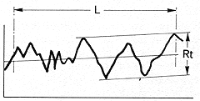
Figure SF-1 — Roughness Rt
Measuring Ra
Ra represents the average deviation of the surface profile from its center line along the Y-axis.
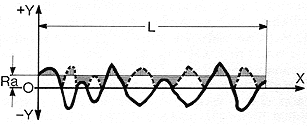
Figure SF-2 — Roughness Ra
Relationship Between Rt and Ra
The relationship between the two surface roughness measurements can be expressed using the following formula:
Rt = (7 Ra + 0.2) ± 35%
This formula is only valid for roughness values over 0.1 µm.
Surface Finish Values and Units
Both Rt and Ra values are expressed in micrometers ( µm). While these measurements do not completely define every characteristic of a surface finish, they provide a useful way to indicate acceptable roughness levels for different parts of a hydraulic cylinder.
The most common metal surface finish has a roughness range of:
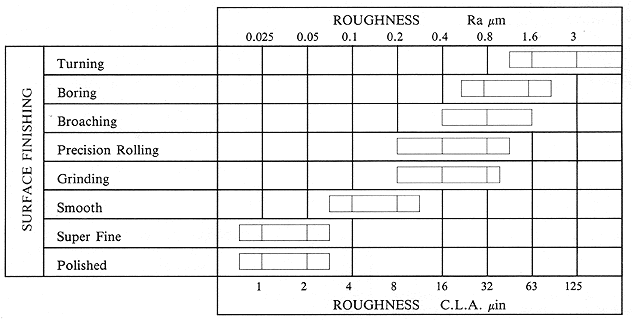
0.02-3.5 µm Ra
Comparing Surface Finish Options
The following EPM reference graph illustrates the relationship between Rt and Ra values across different surface finishing options.
Need Help with Your Hydraulic Sealing Application?
Surface finish is just one of many factors that influence hydraulic seal performance. EPM Inc. helps customers understand their sealing requirements and find products suited to their applications. Contact our team for assistance with hydraulic seals, working conditions, and technical questions.
Contact EPMCall EPM: 1-800-659-5050
Updated 9/25/2026